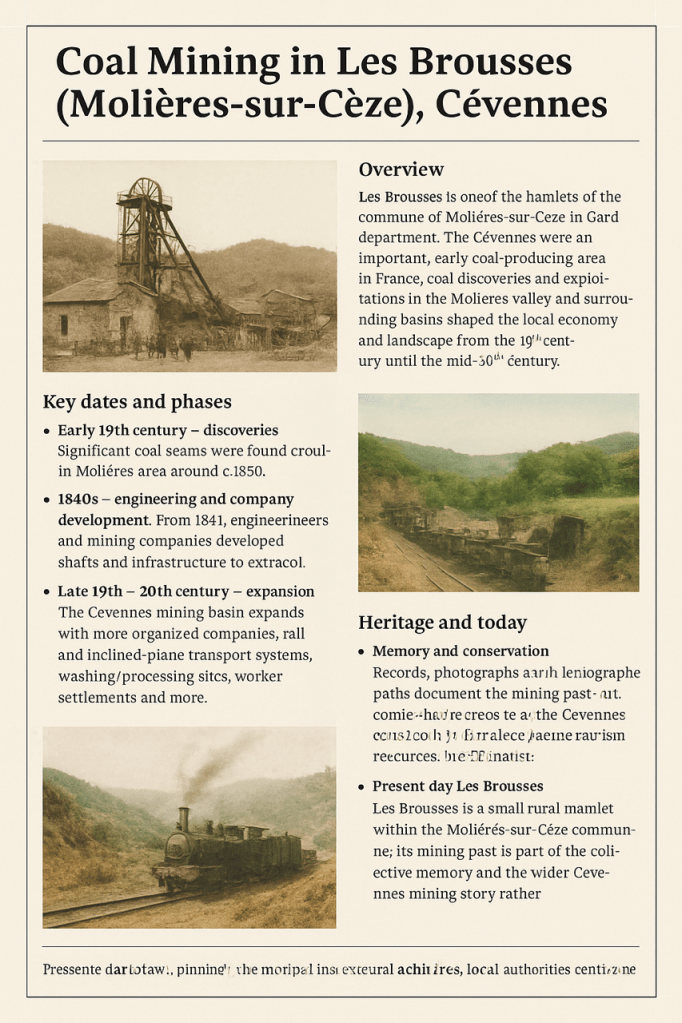
In the early 19th century, as Europe embarked on its industrial journey, the search for energy led deep into the mountains of the Cévennes, a region rich in minerals and the so-called “black gold” of coal. Here, a thriving mining industry emerged, providing work, income, and structure to local communities. Life for the miners was demanding and often dangerous, with shifts running day and night, yet the region flourished as families settled and villages grew. Towns like Alès and Le Grand Combe became centers of activity, while smaller villages such as Saint-Ambroix, Molières-sur-Cèze, and Les Brousses expanded to accommodate the growing population.
By the early 20th century, laborers were even brought in from abroad, reflecting the enduring phenomenon of migration in search of work. Chapels and local meeting places offered spiritual support and moments of reflection, helping miners gather strength for the day ahead. The daily rhythm of life in and around the mines shaped the character of the region, leaving an imprint of resilience and community that can still be felt today.
As the decades passed, the mines gradually fell into decline. By the 1950s, new energy sources such as oil and gas became easier to extract, cheaper to transport, and more accessible. Mines closed, unemployment rose, and many residents, particularly those without ties to agriculture, moved to cities. Villages and communities fell into decay, and the landscape that had once thrived with industry grew quiet and abandoned.
Yet, with time, a new chapter began. Stressed city dwellers, artists, and those seeking a quieter, more reflective life discovered the Cévennes. This vast and diverse countryside, now recognized as one of France’s largest protected natural areas, offered the perfect sanctuary. Slowly, the abandoned villages and old mining buildings found new life as places of creativity, rest, and connection with nature.
Among these remarkable transformations is Citadelle des Cévennes, located in the heart of the former mining area of Les Brousses and Molières-sur-Cèze. What was once a bustling industrial site has been carefully restored into a sanctuary of eight spacious living units, creating a serene enclave where visitors can immerse themselves in the history, beauty, and tranquility of the region. Today, it stands as a testament to the resilience of the landscape and the people who lived here, offering a rare combination of heritage, comfort, and inspiration.
From its roots in the industrious past of the Cévennes to its present incarnation as a place of refuge and creativity, Citadelle des Cévennes invites all who visit to experience the unique harmony of culture, history, and nature in one of Southern France’s most extraordinary regions.

 Citadelle des Cévennes